.avif)
Most foreign companies assume the hard part of Saudi market entry is the licensing. In practice, the corporate bank account is often what actually holds things up. It sits at the end of a chain of dependencies: Commercial Registration, MISA license, national address, General Manager's residency.
And if any one of those isn't fully in place, the bank simply won't open the account. If understood correctly and sequenced properly, your company will not face any issues whatsoever.
Here's what it actually involves.
Why the Bank Account Comes Later Than People Expect
A corporate bank account in Saudi Arabia isn't something you can apply for alongside company formation. It is a part of the process as well. Banks require a valid Commercial Registration, a MISA investment license for foreign-owned entities, notarised Articles of Association, a registered national address, and a Tax Identification Number before they'll even open a file.
For companies with a paid-in capital requirement, part of that capital typically needs to be deposited and certified before the Commercial Registration is finalised. It means the bank relationship actually starts before the entity is fully registered, then continues once it is.
Documents You'll Need to Open a Corporate Bank Account in Saudi Arabia
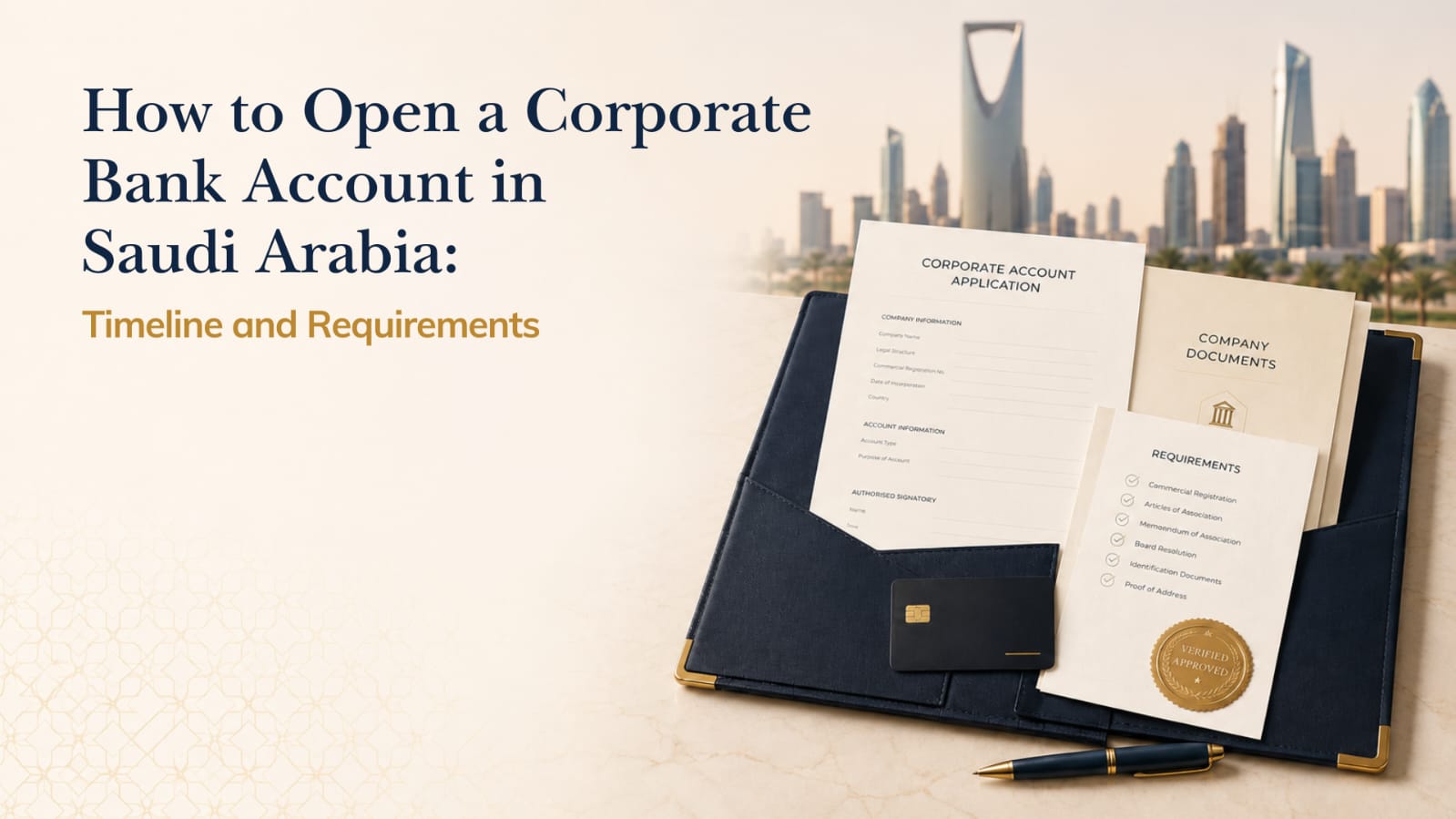
Requirements vary slightly by bank, but the core file is consistent:
- Commercial Registration (CR): issued following complete business registration.
- MISA investment license
- Notarised Articles of Association / Memorandum of Association
- National address registration
- Tax Identification Number (TIN) from ZATCA
- Authorised signatory identification: a valid Iqama, not just a passport
- Parent company documents (certificate of incorporation, board resolution authorising the account, ownership structure), fully attested by the Saudi Embassy in the home country and Saudi's Ministry of Foreign Affairs if the parent is foreign (Source: Al Raee Group)
Banks typically require this documentation to be submitted digitally first, followed by a verification meeting with the authorised signatory before the account is activated.
The Capital Deposit to Open a Corporate Bank Account in Saudi Arabia
Saudi law doesn't set a single statutory minimum share capital for every entity type. But MISA's practice generally expects foreign-owned LLCs to hold at least SAR 500,000 in capital, with some regulated sectors requiring significantly more. Depending on your entity structure (LLC, RHQ or Branch), this capital either needs to be deposited into a temporary account and certified as part of the Commercial Registration process. Or it can sit on the company's balance sheet and be drawn down as working capital once the entity is active.
Which route applies depends on your specific structure and activity, so it's worth confirming early. A shortfall discovered late is one of the more common causes of delay.
Realistic Timeline to Open a Corporate Bank Account in Saudi Arabia
Once your documents are genuinely complete and your authorised signatory holds a valid Iqama, the bank's own processing typically takes three to seven business days. The catch is everything that has to happen before that point.
In practice, the full journey, from Commercial Registration through to a fully activated, operational account, tends to run four to eight weeks, and the variable isn't usually the bank.
It's whether the General Manager's Iqama has come through, whether parent company documents were attested the first time correctly, and whether the capital position matches what the bank expects to see. Companies that line up their GM's residency and Saudization workforce requirements in parallel with company formation, rather than after it, consistently move through this stage faster.
Why Banks Reject Applications
The rejections that actually happen tend to trace back to a handful of recurring issues:
- The authorised signatory doesn't have an Iqama yet. This is treated as a hard stop. A foreign passport alone isn't sufficient, and there's no workaround, including remote or video verification.
- Parent company documents aren't properly attested. Unattested foreign corporate documents are routinely rejected regardless of how official they appear.
- Assuming the account can be opened before the Commercial Registration is finalised. The CR is a prerequisite, not something submitted alongside the bank application.
- Insufficient or undocumented capital. Capital shortfalls and translation errors in supporting documents are consistently cited as grounds for rejected applications.
- Using a virtual office instead of a genuine registered address. Banks verify the national address, and a nominal or virtual listing generally won't clear compliance review.
None of these are unusual or unfair requirements. They're standard KYC and AML checks applied consistently to every foreign-owned entity. The companies that clear this stage quickly are the ones that treat the bank's documentation standard as the baseline from day one, not a hurdle to negotiate around later.
Choosing a Bank
Saudi Arabia's major banks all serve foreign corporate clients, but they aren't interchangeable in practice. Al Rajhi Bank, Saudi National Bank, Riyad Bank, and SABB are among the most commonly used by foreign-owned entities.
Alinma is also frequently cited for digital banking and international transfer capability. Some banks are noticeably faster and more experienced with foreign shareholding structures than others, and account features, minimum balance requirements, and onboarding pace can vary meaningfully between them.
Which bank is the right fit generally depends on several factors. Aspects like your ownership structure, expected transaction volumes, and whether Islamic banking products matter to your treasury setup play a critical role in this.
How Decisive Partners Supports Banking Setup
Decisive Partners manages banking as part of the statutory activation sequence that follows company formation, not as an isolated task handed off at the end. That includes preparing a bank-ready documentation pack, coordinating capital deposit timing against Commercial Registration, and sequencing the General Manager's Iqama so it's in place before the bank application, not after.
Decisive Partners works with a network of 20+ banking relationships across the Kingdom's major institutions, which means the right bank for a given ownership structure or sector can usually be identified and engaged directly, rather than discovered through trial and error.
Brief our advisors to talk through your corporate banking setup. For the steps that come before this one, see our guide to company formation in Saudi Arabia.
Frequently Asked Questions
Q1. How long does it take to open a corporate bank account in Saudi Arabia?
Bank processing itself usually takes three to seven business days once documents are complete. The realistic end-to-end timeline — including Commercial Registration, GM Iqama issuance, and document attestation — typically runs four to eight weeks.
Q2. Can a foreign company open a Saudi bank account remotely?
No. The authorised signatory must be physically present in the Kingdom for biometric (Nafath) verification. See our guide to the GM visa and Iqama process for how to plan the GM's in-Kingdom residency correctly.
Q3. What is the minimum capital required to open a corporate account?
There is no single statutory figure, but MISA generally expects foreign-owned LLCs to hold at least SAR 500,000 in capital. Confirm the exact figure against your specific entity type and activity before applying.
Q4. Does the General Manager need an Iqama before opening the account?
Yes. A foreign passport alone is not accepted. Planning the GM's investor visa and Iqama in parallel with company formation avoids this becoming the bottleneck. See our full guide to the GM visa and Iqama process.
Q5. Why do banks reject corporate account applications?
The most common reasons are an authorised signatory without a valid Iqama, unattested parent company documents, applying before Commercial Registration is finalised, unresolved capital shortfalls, and using a virtual rather than physical registered address.
Q6. Which Saudi banks work best with foreign-owned companies?
Al Rajhi Bank, Saudi National Bank, Riyad Bank, SABB, and Alinma are all commonly used by foreign investors. The right choice depends on ownership structure, transaction needs, and whether Islamic banking products are a priority. Contact our advisors to discuss which bank fits your specific structure.